Focus on Angle: A Key to Upwind Performance
Close-hauled is a groove, not a point. Learning the low, middle, and high edges helps sailors hold better upwind angles more often.
Close-hauled: what is it, and where is it? Some sailors find it and stay in it all the time. Others pass through it but cannot hang around very long. Some practically live on the pinch, never allowing the sail to enjoy great flow and power.
When assessing speed and pointing problems, it is common to find sailors are not sailing on proper angles for some percentage of their upwind sailing time.
What close-hauled is not
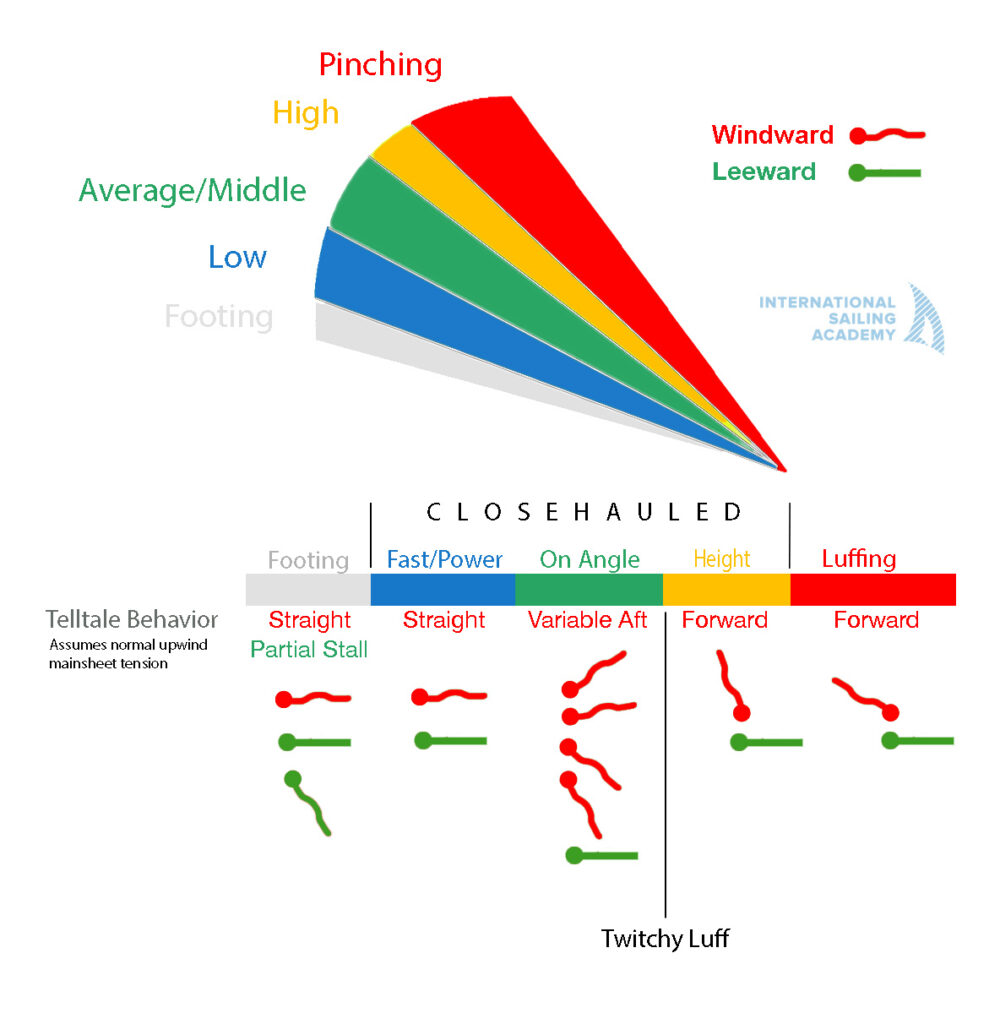
If the sail is luffing, with a visible bubble somewhere on the luff, you are too high. That is not close-hauled. If the sail is stalled, meaning the leeward telltale has dropped with correct mainsheet tension, you are too low. That is not close-hauled either.
Just before those edges are the extreme limits of the upwind groove. Close-hauled is better understood as a region comprising a few zones.
The groove
If sheet tension is correct and both telltales are just starting to fly straight back, you have hit the low side of the groove. It is useful periodically for acceleration, power, or tactical reasons, but rarely should you stay there for long.
Any further down is too low. We can consider that footing, requiring an ease of sheet. It is mainly useful if you know there is a shift or pressure ahead, more of a strategic or tactical choice than a VMG choice.
In the green zone, the leeward telltale always streams straight back. The windward telltale can point straight upward, angle up and back, point down and back, or hang down. If you are going to stay in one place, stay here, and keep the luff as close to twitchy as possible.
In peak performance, many conditions require driving between low, middle, and high, then resetting and repeating. In waves, you may go to the bottom of the groove momentarily with a tiller pull and then back through the middle toward the high side at the top of the wave. The goal is not to end up in the red or grey zones even when steering aggressively to reduce impact.
Indicators
On the MKII sail, any forward windward telltale behavior indicates you are too high. It should almost never go forward on the MKII. On the radial, temporary forward behavior is acceptable.
Telltales are important, but they are not always effective. They can get stuck, get wet, be hard to see in sun angle, or be placed badly. In those cases, concentrate on seeing the luff get twitchy fairly often as your high-side indicator. The middle of the groove is just a little down from there.
The total close-hauled range, or groove, can vary with rig setup and conditions, but the indicators remain the same. The groove may range from roughly two to six degrees.
Placement and attention
The primary telltales should be a few inches forward of the window, away from mast turbulence but not so far aft that they become desensitized. Height-wise, place them in the meat of the sail, higher than the window. Many sailors add a second set higher up.
If you are off target speed for the wind speed, telltale behavior can deceive you. Telltales are most informative when they have good airflow. In light air, get fully up to speed before using telltales to dial in angle, and avoid being overtrimmed while trying to make them look right if you are slow.
Swell can also lead you astray. Apparent-wind changes in the rig can create velocity headers and lifts while true wind remains the same. Many sailors chase these changes with steering, creating too much drag. Small sheeting adjustments can often maintain good flow through the changes.
Sailors should look at telltales or luff roughly one-third of the time on average. Check them when you feel something change and every few seconds to verify flow and angle. The best sailors may sail with perfect telltale behavior around 95 percent of the time.