A Basic ILCA Sailing Fitness Program
A simple two-day strength program for building ILCA-specific strength, durability, and injury resistance.
Having solid strength in the ILCA is a must. Athletes of all levels come off the water and remark that they were fast or slow because of their fitness levels. The immediate thought is often, “I need to get stronger” or “I need more endurance.” Unless you have a coach or trainer who knows the demands of the ILCA, it is easy to knock about in the gym without a plan or direction.
This article is intended to give you a basic strength program that can make you stronger in the boat and help stave off injury.
Important notes
Professional advice matters. Fitness is a lifelong journey of improving form and gaining strength. If you lack experience, a keen eye can get you moving faster and safer.
Flexibility matters. It is nearly impossible to do the movements correctly without adequate flexibility throughout the body. It also promotes safety and recovery, so every strength session should begin with a solid warm-up and stretching, and finish with stretching again.
Diet matters. Adequate nutrition is paramount for any athlete. If you are in a caloric surplus, you gain weight; if you are in a caloric deficit, you lose weight. Mass is gained or lost as a combination of fat and muscle.
Form matters more than load. It is far more important that the exercises are done correctly and through full range of motion than it is to increase weight or reps. Training partners, professional help, or video analysis of your workouts can help you keep improving form.
The training concept
The focus of this program is gaining muscle mass through hypertrophy: increasing the size of a muscle by adapting to volume stimulus. For the movements that require weight, work with roughly 60–75% of your one-rep max and complete 6–12 reps for three sets. If you do not know your one-rep max, choose a weight you can lift with solid form for 10 reps.
Use progressive overload. Each week, look to add 5–10 lb where appropriate so your body keeps adapting. If you always use the same weights, your body adapts and stops growing.
Workout A — Push
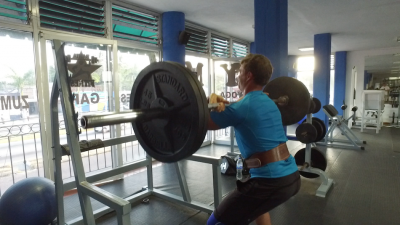
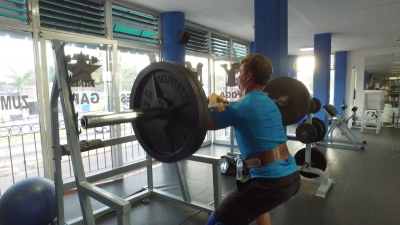
Back squat: 3 sets x 10 reps at 60–75% of 1RM. Hit full depth, with quads parallel to the floor, spine straight, and core braced.
Incline press: 3 sets x 10 reps at 60–75% of 1RM. Use dumbbells or a barbell on an incline bench, with spine flat against the bench.
Single-leg extension: 3 sets x 10 reps at 60–75% of 1RM. Use one leg at a time, accelerate forcefully upward, and control the downward phase. No swinging.
Standing strict shoulder press: 3 sets x 10 reps at 60–75% of 1RM. Brace core and glutes, and use only shoulders and arms to move the bar overhead.
Back extension: 3 sets x 10–20 reps. Brace the core and keep a neutral spine. This strengthens the lower back but should be felt primarily through the glutes. When 20 reps becomes too easy, hold weight to increase difficulty.
Workout B — Pull
Deadlift: 3 sets x 10 reps at 60–75% of 1RM. Keep a neutral spine, brace the core, and focus on pulling with the glutes.
Pull-up: 3 sets x 10 reps. If you cannot do a pull-up, jump to the top position and slowly lower yourself. If 10 reps is easy, add reps or a weight belt. This is an important exercise for the ILCA.
Single-leg hamstring curl: 3 sets x 10 reps at 60–75% of 1RM. Use one leg at a time, accelerate hard on the pull, and control the return. No swinging.
Hanging leg raises: 3 sets x 10 reps. From a neutral position with straight legs, raise your legs to 90 degrees and control both the upward and downward phase. If these get too easy, try toes to bar. No swinging from the bottom.
Ab wheel rollouts: 3 sets x 10 reps. Start on your knees and fully extend. Keep the back straight; if you cannot extend all the way, stop where your form begins to break down.
Consistency
Complete these workouts 3–5 times per week and rotate them. For example: week one, ABA; week two, BAB. For overload, keep adding weight and volume for three consecutive weeks. The fourth week should be a deload week at roughly 50% of the load and volume so the body can refresh and recover while maintaining strength gains.
The most important thing is the quality and consistency you train with. This program is a guide to build well-rounded strength for the ILCA, but it will not help unless you put in the work week over week and month over month. If you nail consistency and train with quality, you will see a big change in the boat.