Rule 42 Downwind Sailing Explained
A practical explanation of Rule 42, rocking, rolling, and what is permitted when sailing an ILCA downwind.
We receive many comments about our videos and Rule 42, especially on the run. Sailors look at downwind footage and ask whether it is legal, or they hear a whistle behind them and feel mistreated based on their interpretation of the rules versus the jury’s.
They might be sailing close to the line between legal and prohibited. The jury’s angle might produce a bad call. Or intentionally or not, they might simply be cheating. At the Worlds, downwind rocking penalties were among the most common after start penalties.
The question
What is legal and what is not? Is there a grey area? What about subjectivity, pack behavior, and the effect on Rule 42 penalties? Do sailors need to push the limits to be competitive? Why do sailors with poor technique get flagged more often?
The starting point is Rule 42, its interpretations, and the exceptions related to rocking and rolling. World Sailing interpretations matter because they are the lens juries use.
Definitions
A roll is a single cycle where the mast goes to leeward and back to windward, or vice versa. Rocking is repeated rolling of the boat. Repeated means more than once on the same area on a leg.
Rule 42.1 says a boat shall compete using only wind and water to increase, maintain, or decrease speed. The crew may adjust trim of sails and hull and perform acts of seamanship, but shall not otherwise move bodies to propel the boat.
The “clearly propels” phrase is crucial. If the action itself would clearly propel the boat, it is not legal. A kinetic technique not listed as permitted and that propels the boat is prohibited.
Rocking
Rule 42.2 prohibits rocking: repeated rolling of the boat induced by body movement, repeated adjustment of sails or centerboard, or steering.
This matters because rocking is defined as repeated rolling. A single roll induced by these actions is not prohibited by this rule as long as it does not clearly propel the boat.
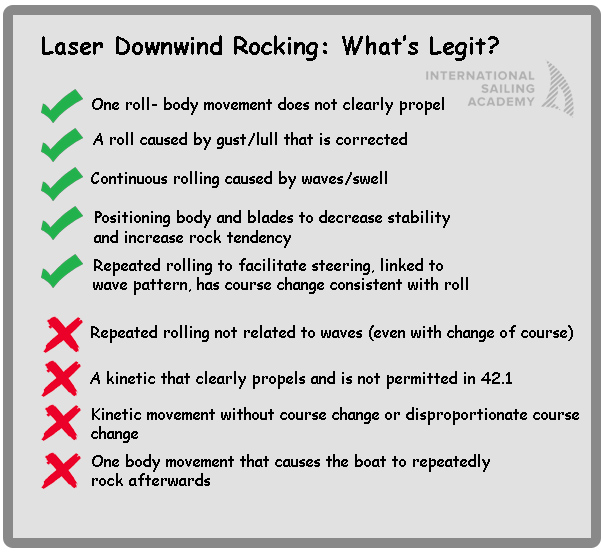
A roll caused by a gust or lull followed by corrective body movement to restore proper trim is permitted. One roll that does not clearly propel the boat is permitted. Background rolling is permitted and a boat is not required to stop it. Static crew position or static sail and centerboard settings are permitted, even when stability is reduced. A single body movement that is immediately followed by repeated rolling is prohibited.
The key
We can maximize the natural tendency of the boat to rock if desired with body position. In the right conditions, being reactive to gusts and lulls is legal and can be beneficial. We can also use one roll that is not propulsive by itself.
The key is that judges should only flag if they are sure the body movement is directly responsible for the speed increase. If beneficial natural rock is happening due to swell or wave action, it is not a problem to let it continue.
The steering exception
Rule 42.3 says a boat may be rolled to facilitate steering. This is the big one for rocking. It turns off previous restrictions on rolling with the caveat that you must be facilitating steering and the roll must be linked to the wave pattern.
Heeling to windward to bear away and heeling to leeward to head up are permitted, but the heel must be consistent with the boat’s turn. Repeated rolling not linked to wave patterns is prohibited even if the boat changes course with each roll.
You cannot initiate huge leeward heel and flatten with only a small course change, even in large waves. But sailors are expressly permitted to roll the boat to facilitate steering, repeatedly, as long as it is linked to the wave pattern, does not clearly propel by itself, and is proportionate to wave size.