ILCA Sailing Tips: Reading the Wind on the Water
The boat tells you what has happened; the water tells you what is coming. Reading ripples builds anticipation instead of reaction.
Sailing is a sport where feel is very important. If you are doing something wrong, the boat feels bad. Over time, corrective actions can become so tuned that you sail without ever getting a bad feeling. That is anticipation. But there is more than one way to handle each error detected, and that is where reading wind on the water matters.
Without understanding the problem, sailors bounce from one error to the next, using the extremes to determine the correct path. Maintaining optimal course upwind can feel like walking down a dark, narrow hallway without bumping into the walls.
Judgment calls
The only way we are fed different stimulus is through changes to helm in the boat. Weather helm makes the boat feel like it wants to head up, and lee helm makes it feel like it wants to bear away.
A lift can feel like a gust, or vice versa. In less wind, a lift can feel like a header if the sail stalls. Sailing into a lull can feel like pinching. Sailing into waves can feel like a lift.
How you react can be the difference between maintaining top boatspeed and creating errors that get massively amplified over a race course. Each situation has a different method of handling it, and the differences can be subtle.
Why water matters
Reading wind on the water is the key to making the best judgment before speed is compromised. Many lifelong sailors do this intuitively, but many people answer “telltales” or “wind vane” when asked how they know where the wind is coming from.
They have never trained their eyes to look at ripples on the water. Water tells you what is coming. Water does not change when your boat changes. It is not affected by the rocking of your boat. You can see it upwind and downwind.
Water can give you ladder rungs, puffs, lulls, shifts, line bias, tacking angles, and jibing angles. Looking at the water is like drawing a map of what could happen, while signs on the boat indicate what has already happened. Any tool on your boat shows a change in apparent wind that has already happened.
A light-air example
Many sailors struggle in light wind. They can be quick in breeze because they love sailing by feel, but in light wind there is less feel, so they search for it. If they get more pressure in the sail, they head up without asking whether it is a lift or gust. If they go too high and pinch, loss of power tells them to bear away without considering whether it is a lull or pinching.
They are reacting quickly to stimulus learned over years, but without a true change in wind direction there should usually be minimal course change. Most of the time, they are sailing through small pressure differences. If they watched the ripples, they would see their optimal upwind angle is not changing. The boat is asking for an adjustment of weight or sail settings, not heading.
What to look for
As wind breaks the surface tension of the water, it makes small ripples. Over time and distance, ripples become waves. Even when there are waves, ripples still exist as long as there is wind.
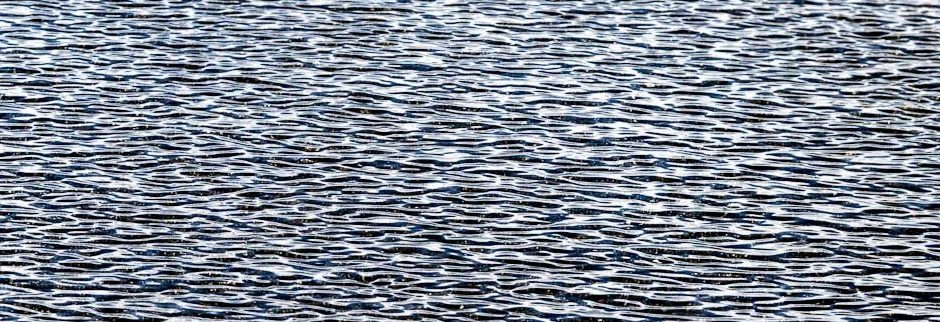
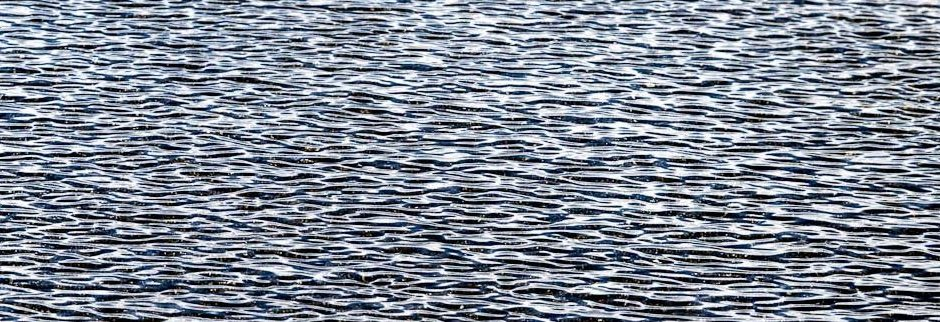
When wave direction is not lined up with wind, ripples can be more confusing. To determine wind direction, look back and forth across a horizontal plane about 10–15 meters long in front of you. Try to see how the wind makes small two-to-four-inch banana-shaped curves. One curve connects to another, almost creating clear horizontal lines.
Activity
Use your hand as a pretend boat. Imagine what close-hauled on starboard looks like, then find port tack. Picture a boat sailing straight downwind, then imagine the by-the-lee angle.
The more you use your hand to find boat angles, the more you look at the ripples and create a visual angle between ripple lines and the boat’s sailing line.
The most critical use of this is lighter wind. Next time, practice watching the ripples not just in front of the bow but several meters upwind and across the wind. Then try it downwind. Watch how ripple angles approach your leech when sailing by the lee, then try to guess the opposite by-the-lee angle without jibing.